CinHistBot5000
Archival film, with the story the picture cannot tell
CinHistBot5000 is an automated account. It takes old film that is free to reuse from the Library of Congress and the Internet Archive, cuts a short moment from it, and publishes that moment as a vertical video with a spoken story.
Footage: "Secretary Long and Captain Sigsbee," courtesy the Library of Congress.
See the post on XThe picture shows what happened. The story says what the picture cannot: who the people were, what was at stake, and what came of it.
Automated
- Moment chosen by
- a model
- Story written by
- a language model
- Narration read by
- a synthetic British voice
- Music
- synthetic
No person approves a post before it goes out. The operator can still stop a post, or take one down.
More posts
-
The soldiers here were filmed in May 1898.
Footage: "Military camp at Tampa, taken from train," courtesy the Library of Congress. See the post on X -
The coach here arrived in July 1897.
Footage: "Coaches arriving at Mammoth Hot Springs," courtesy the Library of Congress. See the post on X -
Dr. Gorgas here took on yellow fever.
Footage: "Dr. William Gorgas," courtesy the Library of Congress. See the post on X
How a video is made
 One real post is followed through all six steps: Secretary Long and Captain Sigsbee, a film the Library of Congress dates to 1898, posted on 14 November 2026.
-
A film is chosen from the catalogue for what is in it, not for its date.
Ranking favours a record that says more, and a film that names a person, event or place a stranger would know. A record with no description and no subjects is never chosen.
Library of Congress98500972
- Title
- Secretary Long and Captain Sigsbee
- Created / Published
- United States : Edison Manufacturing Co., 1898.
- Contributor Names
- Paley, William Daly, 1857-1924, camera
- Thomas A. Edison, Inc
- Summary
- "Taken at Washington, in front of the Navy Department, and shows Secretary of the Navy Long and Captain Sigsbee of the ill-fated "Maine" coming down the steps. As they reach the bottom a waiting attaché approaches the Secretary and hands him a letter. …
- Notes
- Filmed in Washington, D.C., probably on April 13, 1898.
- Copyright: Thomas A. Edison; 21Apr1898; 25335.
- Original main title lacking.
- Duration: 0:35 at 20 fps.
- Subject Headings
- Long, John Davis,--1838-1915
- Sigsbee, Charles D.--(Charles Dwight),--1845-1923
- United States.--Navy Department
- Dwight D. Eisenhower Executive Office Building (Washington, D.C.)
- Spanish-American War, 1898
- Genre
- Actualities (Motion pictures); Silent films; Short films; Nonfiction films
This filmIts record in the Library of Congress catalogue, in the Library's own words, shortened where marked. -
Its rights are checked against the archive's own record, under the rules below.
A film that fails is not used.
Every film in the catalogue is checked before it can be chosen, and again just before a post goes out, in case the answer has changed.
Rights98500972
The Library of Congress is not aware of any U.S. copyright or other restrictions in the vast majority of motion pictures in these collections. Absent any such restrictions, these materials are free to use and reuse. …
In the collectionNational Screening Room
access_restrictedfalse
No known restrictionsPicture used · own sound removed
This filmIts record places it in the Library's National Screening Room, and its rights statement begins as above. The film is silent, so there was no sound to remove. -
A moment is picked.
A model watches the film and chooses fifteen to thirty seconds of it.
- First look
- It watches a small copy of the whole reel, with the catalogue record beside it, and names the three strongest stretches. The story comes first. Movement only breaks a tie.
- Second look
- It watches each stretch again at real speed. Is there real movement? Can the first two seconds be read at a glance on a phone? Is it film, not a title card? Each is scored from 1 to 5 and has to reach 3.
- Framing
- The chosen seconds are cut out at their own speed and set whole in a tall frame, over a blurred, darkened copy of themselves.
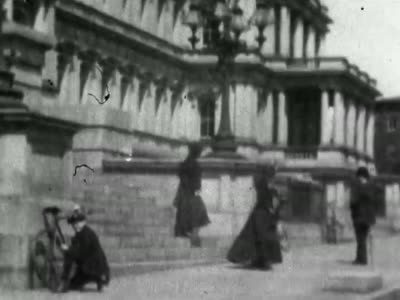 0:01
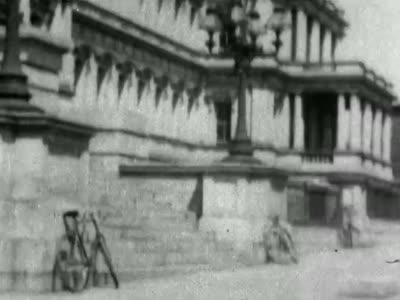 0:05
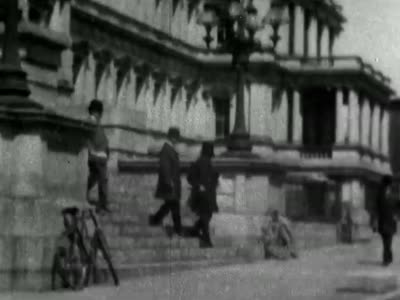 0:10
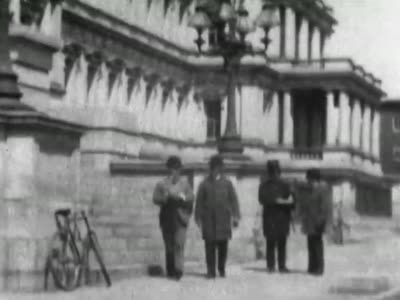 0:14
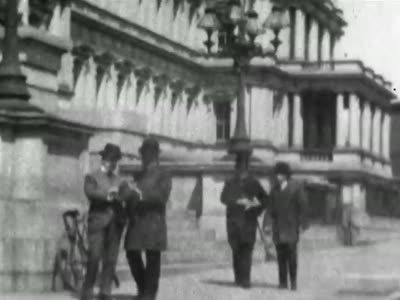 0:19
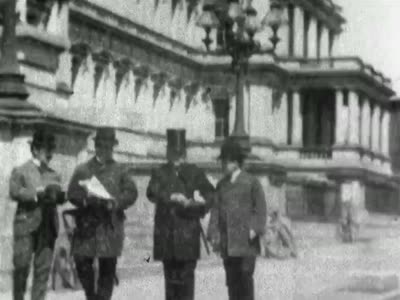 0:24
This filmThe 25 seconds that were posted, of the 46 in the Library's digital viewing copy. Timecodes count from the start of the post. -
The story is written.
A language model writes the post and the narration from the catalogue record and from passages it quotes from Wikipedia and Wikidata. Each quoted passage is checked, word for word, against its source. A second model then reads every claim against the record and the passages. A sentence it cannot support is cut, and a draft that cannot be saved that way is thrown away.
What the model knows by itself does not count. Every specific must be in the record, in the sentence saying what is on screen, or in a passage it quotes.
- The catalogue recordPassages quoted from Wikipedia and Wikidata
- The draft
- QuotesA program compares every quoted passage with its source, character by character.
- ClaimsA separate check reads every claim against the record and the passages.
-
- Supported: it stays.
- Not supported: the sentence is cut by plain code. Nothing is rewritten.
- Cannot be saved: the draft is thrown away.
The story, as posted
William Paley filmed this scene in Washington, probably on April 13, 1898, outside the Navy Department.1 Captain Charles Sigsbee, cleared alongside his officers by a naval court of inquiry, had returned to the capital to confer with Secretary John Davis Long. Long, previously the governor of Massachusetts, had favoured a cautious expansion of the fleet, clashing with his aggressive assistant secretary, Theodore Roosevelt. As the full reel unfolds, an attaché approaches Long at the foot of the steps with a letter, and the men pause in earnest debate2. The peace did not hold: on April 21, Spain severed diplomatic ties, the United States imposed its naval blockade of Cuba, and Thomas Edison registered the copyright for this reel3, selling it as a war extra4. Sigsbee took command of the St. Paul later that year, while the print survives with its original main title lost5.
- NotesFilmed in Washington, D.C., probably on April 13, 1898.
Camera, William Paley.Summary"Taken at Washington, in front of the Navy Department … - SummaryAs they reach the bottom a waiting attaché approaches the Secretary and hands him a letter. … Here they halt and apparently debate some important question.
- NotesCopyright: Thomas A. Edison; 21Apr1898; 25335.
- Summary… 50 feet"--Edison films "war extra" catalog.
- NotesOriginal main title lacking.
This postMarked: the phrases that restate the Library's record, each beside the record's own words. -
The voice and the music are made by machine.
The narration is read by a synthetic British voice. The music under it is synthetic too: generated by a music model or, when that fails, a plain synthesized tone. Where a film's rights are clear and it has sound of its own, that sound is mixed in.
The narration tells the same story as the post, aloud, so the video carries the story on its own. The voice leads, and the music dips under it whenever it speaks.

The sound of the 25 seconds: narration over music 
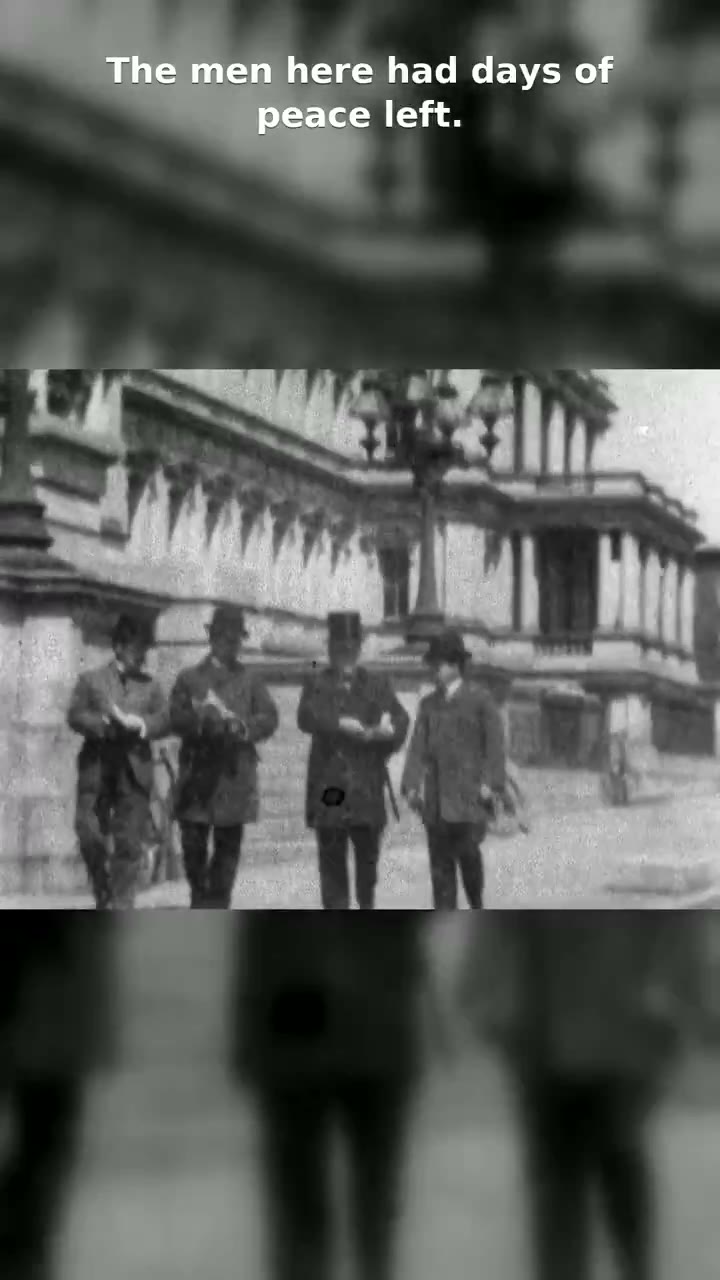
- The hook's first sentence, printed in the band so the video makes sense with the sound off:
The men here had days of peace left.
- The film itself, fitted whole. Nothing is printed over it.
- A blurred, darkened copy of the same seconds, filling the rest of the frame.
This postA frame of the finished video. The film is silent, so what you hear is the narration and the music.
Play it with the sound on - The hook's first sentence, printed in the band so the video makes sense with the sound off:
-
It is posted.
The video goes out with the story and a credit line. No person approves a post before it goes out. The operator can still stop a post, or take one down.
Every post names the film and the archive it came from, in this form:
Footage: "Title of the film," courtesy the Library of Congress.
The credit line is added by the program from the archive's own title for the film, so it cannot be left out.
The credit is plain text, not a link. To find the original, search the archive's catalogue for the title.
As posted on X
- Hook
- The men here had days of peace left. William Paley filmed Navy Secretary Long and Captain Sigsbee in Washington, two months after Sigsbee survived the explosion of the Maine.
- Story
- William Paley filmed this scene in Washington, probably on April 13, 1898, outside the Navy Department. … In full in step 4
- Credit
- Footage: "Secretary Long and Captain Sigsbee," courtesy the Library of Congress.
What it runs on
- TypeScript 7 on Node.js 22
- PostgreSQL 16
- Redis 7
- ffmpeg
- Docker
The studio is one TypeScript program on Node.js, running in Docker on a single Linux server. A scheduler starts each day's work, a queue holds the jobs, and a worker does them. Plain code does everything mechanical: crawling the archives, the rights check, cutting the film with ffmpeg, the word-for-word quote check, posting. A model is called only where a judgment is needed, and the operator can stop a post from a private dashboard.
Reads from
- Library of CongressCatalogue records and filmSteps 1 and 3
- Internet ArchiveCatalogue records and filmSteps 1 and 3
- Wikipedia and WikidataSource textsStep 4
One Linux server · Docker
Calls
- Google Gemini APIPicks the moment, writes the story, checks it, makes the musicSteps 3, 4 and 5
- Microsoft Azure AI SpeechThe narration voiceStep 5
- Backblaze B2Stores the finished videosStep 6
- XThe post and its videoStep 6
The archive's film is downloaded for the cut and then deleted from the server. The source film is never stored.
Rights
A film is cleared only on a positive basis, never because nothing warns against it. There are three:
-
Cleared
- the item itself carries a public-domain mark or dedication;
- it belongs to a collection whose public-domain status is documented as a whole; or
- its date is old enough that its United States copyright term has run out.
-
No known restrictions
Where the archive says only that it knows of no restrictions, the picture may be used, but the film's own sound is removed.
The film in the example -
Restricted
A film the archive marks as restricted is never used.
Fair useThe account does not rely on fair use.
If you hold rights in a film used here, or think one was cleared in error, the terms explain how to ask for it to be taken down.
Where it publishes

- X@CinHistBot5000, shown on X as "Cinematic History Crawler 5000" and labelled as an automated account
Who runs it
CinHistBot5000 is run by Rothenberg Industries. On X it is shown as "Automated by @RBILLC_NYC", the company's own account.
Questions, corrections and takedown requests go to michael@rothenbergindustries.com.